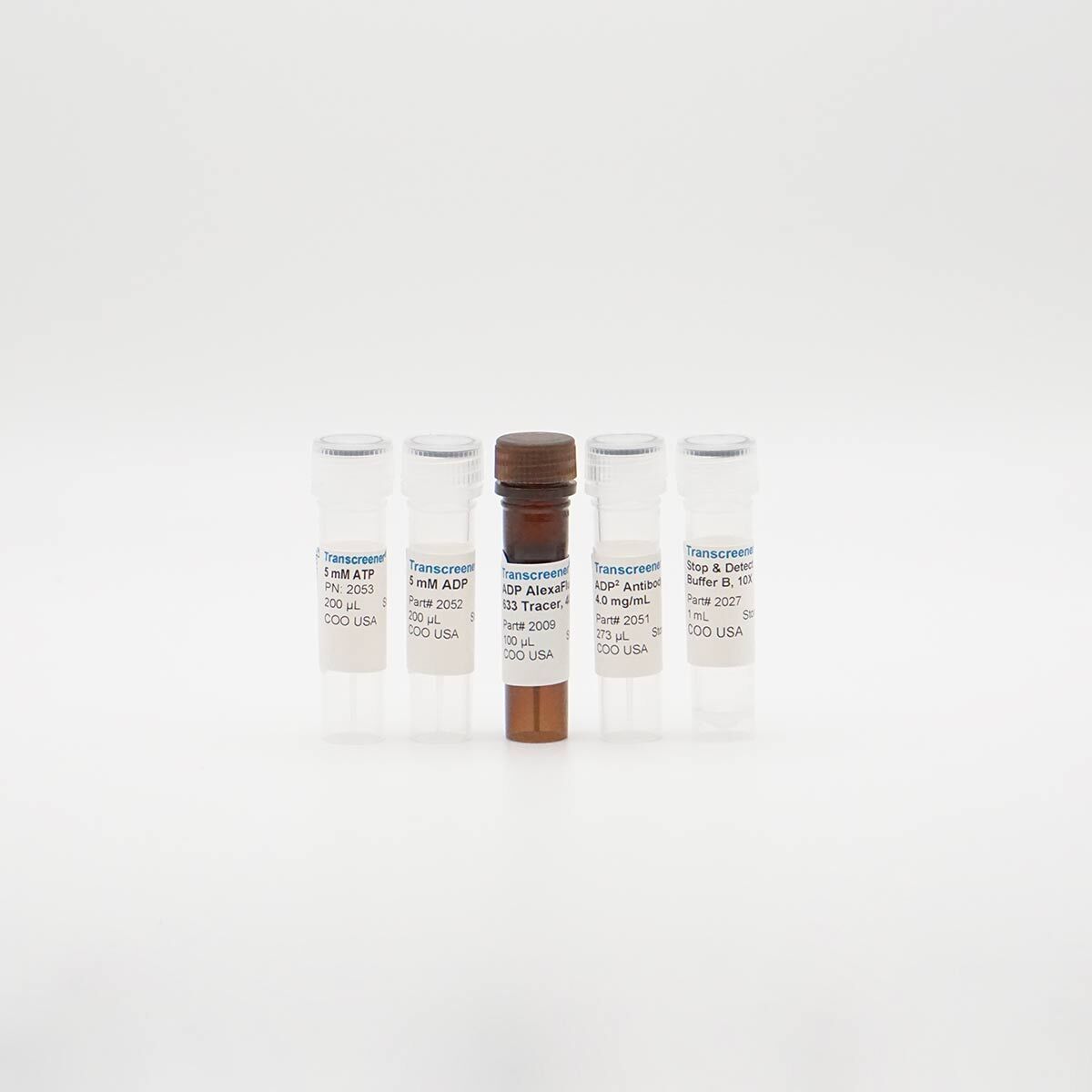
Transcreener ADP² Kinase Assay Kits

Transcreener ADP2 Kinase Assay Kits

Single-Step Kinase Activity Assay Kit for Screening and Lead Discovery
  • Direct ADP Detection

    → Avoid false positives by eliminating coupling steps and interference.
  • Universal Across Kinases

    → Use a single assay kit for any kinase family, simplifying assay development.
  • HTS Ready

    → Compatible with 96-, 384-, and 1536-well plates; robust Z’ factors > 0.7 ensure reproducible screening.
  • Proven Performance

    → Trusted by leading pharma and biotech labs worldwide for kinase inhibitor discovery.
  • Ultra-sensitive

    → Requiring less enzyme saves money and provides more accurate results.
  • Flexible

    → Use continuous or end-point assay methods and with any ADP-producing enzyme.

Is your plate reader compatible?    Find out now!

Custom Sizes and Bulk Pricing Available Contact Us for an HTS-scale Quote!

SKU: N/A Category: Tag:

Overview – Transcreener ADP2 Kinase Assay Kits

Streamline your kinase screening with BellBrook’s Transcreener ADP² Kit. This one-step, mix‑and‑read assay directly detects ADP—the universal kinase reaction product—across any enzyme target. Compatible with FP, FI, and TR‑FRET detection formats, it supports 96-, 384-, and 1536‑well plates and delivers reliable high-throughput data with minimal interference, all while reducing your assay development time.

The Transcreener ADP² Assay is a universal kinase assay kit , compatible with a wide range of kinases and substrates. Its high sensitivity allows for accurate detection even at low ATP concentrations, making it ideal for challenging targets.

What Are Kinase Assays and Why Do They Matter?

A kinase assay is a laboratory method used to measure the activity of kinase enzymes—proteins that transfer phosphate groups from ATP to specific substrates such as proteins, lipids, or carbohydrates. This phosphorylation process regulates essential cellular functions, including signal transduction, metabolism, growth, and survival.

Because dysregulated kinase activity is a hallmark of many diseases, such as cancer, inflammatory disorders, and metabolic syndromes, kinase assays are critical tools in drug discovery and development. By detecting ADP production (the universal product of kinase reactions), researchers can quantify enzyme activity, evaluate inhibitor potency, and screen large compound libraries efficiently.

How a Kinase Assay Works

Why Transcreener Outperforms Other Assays?

Feature
Transcreener
Other ADP Assays
Direct Detection of ADP
Check Mark Icon
cross out icon
Single Addition Mix-and-Read
Check Mark Icon
cross out icon
< 10 nM Sensitivity
Check Mark Icon
cross out icon
Can Be Used In Continuous Mode
Check Mark Icon
cross out icon
Overnight Signal Stability
Check Mark Icon
cross out icon
Multiple Detection Modes Available
Check Mark Icon
cross out icon

Here’s Why Researchers Choose Transcreener

Transcreener ADP Kinase Assay Kit directly measures ADP produced by kinases. These ADP measurements allow researchers to effectively determine the activity of the kinase enzyme. The assay provides a powerful tool to screen compound libraries for kinase modulators to help find new therapies for disease.

Kit contents:

  • Complete set of detection reagents required to measure activity.
  • Note: Kinase enzyme is not included in the inhibitor screening assay kit. Please contact us for questions related to acquiring the enzyme.

Success stories using Transcreener’s ADP Kinase Assay Kit:

  • Eli Lilly discovered and patented Aurora A Kinase Inhibitors for cancer therapeutic development.

  • Researchers at the University of Wisconsin – Measured helicase activity to identify small molecule inhibitors as potential hepatitis C treatments.

How Does the Assay Work?

The Transcreener Kinase Assay Kit determines kinase enzyme activity by directly measuring the ADP formed by the enzyme using the Transcreener ADP2 Assay. By detecting ADP output, the assay provides a universal method to assess the activity of any ADP-producing enzyme in real-time.

Transcreener Kinase Assay technology uses a simple but highly effective method that consists of an antibody selective to ADP over ATP and a far-red fluorescent tracer. ADP produced in the reaction competes with the tracer changing the fluorescent properties and providing fluorescent readout.

The kinase assay kit is available with FP, FI, and TR-FRET. It is a simple mix-and-read format. Perform your enzyme reaction, add the detection reagent, and measure. The simplicity of the system yields robust results that also makes it extremely amiable to HTS.

Transcreener ADP Kinase Assay Schematic

By measuring a common product of enzyme reactions such as ADP, the assay is universal, meaning it can be used to measure the activity of any enzyme that produces that product. Learn more about how Transcreener works, including its three fluorescent readouts.

Finding the right enzyme activity assay is crucial for drug discovery. Transcreener is ultra-sensitive, simple, robust, and accurate, making it easily scalable for high-throughput screening (HTS) and flexible enough to run in kinetic mode for streamlined assay development and SAR studies.

Run Kinase Screens with Fewer False Positives

Direct ADP detection eliminates coupling artifacts and improves data confidence in HTS.

Learn more in this poster.

This field is for validation purposes and should be left unchanged.
Name(Required)
Download Icon

Specifications

What’s Included

FP
1K10K
ComponentPart #QtyPart #Qty
ADP Alexa633 Tracer, 400 nM
2009100 µL20131 mL
ADP2 Antibody, 4.0 mg/mL2051273 µL20542.73 mL
Stop & Detect Buffer B, 10X20271 mL203210 mL
5 mM ADP2052200 µL20552 mL
5 mM ATP2053200 µL20562 mL

FI
1K10K
ComponentPart #QtyPart #Qty
ADP Alexa594 Tracer, 800 nM2073100 µL20751 mL
ADP2 Antibody-IRDye® QC-1, 1.73 mg/mL2074542 µL20765.42 mL
Stop & Detect Buffer B, 10X20271 mL203210 mL
5 mM ADP2052200 µL20552 mL
5 mM ATP2053200 µL20562 mL

TR-FRET
1K10K
ComponentPart #QtyPart #Qty
ADP HiLyte647 Tracer, 10 µM2060200 μL20632 x 1 mL
ADP2 Antibody-Tb, 800 nM2061100 µL20641 mL
Stop & Detect Buffer C, 10X20621 mL206510 mL
5 mM ADP2052200 µL20552 mL
5 mM ATP2053200 µL20562 mL

What You Will Need

ComponentNotes
Kinase EnzymePlease use purified enzymes for the best results. Looking for a kinase? Contact us to see if we've tested it with our assay.
Enzyme BufferUser-supplied enzyme buffer components include enzyme, buffer, acceptor substrate, MgCl2 or MnCl2, Brij-35, and test compounds.
Assay PlatesAssay Plates Can Be Purchased Separately From BellBrook Labs.

FP - An entirely black plate with a non-binding surface is required. We suggest Corning 384-well plates (Cat. #4514) or 1536-well plates (Cat. #3728).

FI - An entirely black plate with a non-binding surface is required. We suggest Corning 384-well plates (Cat. #4514), Corning 96-well, half-area plates (Cat. # 3686) or 1536-well plates (Cat. #3728).

TR-FRET - An entirely white plate with a non-binding surface is required. We suggest Corning 384-well plates (Cat. #4513) or 1536-well plates (Cat. #3729).
Plate ReaderA multi-detection microplate reader configured to measure the output of the ADP tracer is required.
Liquid Handling DevicesUse liquid handling devices that can accurately dispense sub-microliter volumes into 384-well plates.
Ultrapure WaterSome deionized water systems are contaminated with nucleases that can degrade both nucleotide substrates and products, reducing assay performance. Careful handling and use of ultrapure water eliminates this potential problem.

A Simple Two-Step Format (No Coupling Enzyme Needed)

The enzyme reaction begins with the addition & incubation of SRC enzyme and substrate. Transcreener ADP Antibody & Tracer are then added & incubated. A compatible plate reader reads the plate.

Transcreener ADP Assay Outline

Robust HTS-Ready Assay

Z’ data confirms the robustness of the SRC kinase assay. A robust assay is necessary to ensure accuracy and efficiency to scale up for high-throughput screening. The Z’ shown here demonstrates the assay is optimal for HTS.

Z' Data for Transcreener ADP Assay

Features

Feature Description / Benefit
Universal ADP Detection Works with virtually any kinase enzyme—protein, lipid, or carbohydrate—as well as other ADP-producing enzymes like ATPases and helicases. Enables one consistent assay platform for all targets.
Ultra Sensitivity Detects <10 nM ADP, capturing even low-turnover enzyme reactions and subtle activity differences. Ideal for weakly active or difficult-to-measure kinases.
Low Interference, Far-Red Detection Far-red fluorescent readout minimizes compound fluorescence and interference, producing clear, reliable data for screening and inhibitor profiling.
Homogeneous, One-Step Format Simple mix-and-read workflow accelerates setup, reduces handling steps, and enhances consistency across runs.
Robust Assay Performance (Z’ > 0.7) Demonstrates excellent reproducibility and data quality—essential for high-throughput screening (HTS) scalability.
Wide ATP Concentration Range (0.1–1000 µM) Supports a broad range of kinase classes and experimental conditions, providing maximum assay flexibility.
Multiple Detection Modes (FP, FI, TR-FRET) Compatible with most standard plate readers and easily integrated into preferred detection formats.
Continuous or Endpoint Mode Enables both kinetic and endpoint measurements for a variety of study designs.
Non-Radioactive Method Safe, environmentally friendly alternative to radiometric assays, eliminating hazardous materials and waste disposal concerns.

Rock-Solid Reagent and Signal Stability Ensures High-Quality Data and Simplifies Automation

Transcreener ADP Reagent and Signal Stability Diagram

The Transcreener ADP2 antibody and tracers are stable at room temperature for a minimum of 8 hours. The outstanding reagent and signal stability make Transcreener ADP2 Kinase Assays highly reliable and easy to use in an automated HTS environment.

Screen for Inhibitors of Kinases, ATPases, and More

Pilot Screen for WRN Helicase

Measuring the ATPase Activity of WRN Helicase in a Pilot Screen Using the Enzolution WRN Helicase Assay System and the Transcreener ADP² FP Assay.

Follow-Up DRCs and Profiling Made Easy

Dose Response Data With WRN Helicase Assay

Measuring the ATPase Activity of WRN Helicase in Dose-Response Mode Using the Enzolution WRN Helicase Assay System and the Transcreener ADP² FP Assay. IC50 = 30 nM

Targets

Universal Kinase Assay Kit – Use with Virtually Any Kinase

Overcome the need for time-consuming, one-off development for individual members within an enzyme family by using a single set of reagents that detect the invariant product – ADP. This protein kinase assay can be used with virtually any substrate, including peptide substrates, protein substrates, and lipid substrates.

Example enzyme targets include:

  • Protein kinases
  • Lipid kinases
  • Carbohydrate kinases
  • ATPases
  • Chaperonins (Hsp90, etc.)
  • Nucleotidases
  • Carboxylases
  • Helicases

Kinase Assay Services

Interested in moving your program forward, but don’t want to bring an assay in-house? Our scientists can help! BellBrook scientists will use their extensive biochemistry and enzymology expertise to work with you and accelerate your kinase program.

Lead Discovery Services Include:

  • Inhibitor Screening

    To identify or confirm activity with the target.

  • Inhibitor Potency Profiling

    Dose-response with target and/or related proteins. Fast IC 50 results.

  • Residence Time Measurements

    Determination of k off using ‘jump dilution’ enzymatic assay method.

  • Mechanism of Action Studies

    Kinetic analysis to define the mode of inhibition.

Contact Us for Services

Please fill out the form below. We will respond quickly to get the conversation moving and learn how we can help. We keep things discrete, confidential, and professional.

Name(Required)

Kinases As Therapeutic Targets

Kinases transfer a phosphate to a protein. Kinases play important roles in cell proliferation, survival, and migration. They regulate cellular function through their ability to turn protein function on. When mutation or deregulation occurs, kinases have been associated with carcinogenesis and metastases of various types of cancer (Bhullar et al, 2018).

Examples of current kinase inhibitors used in clinical treatments include imatinib and dasatinib. These treatments have seen great success for myeloid leukemia (CML) and gastrointestinal stromal tumors (GIST), showing a significant increase in patient survival. The FDA has now approved several small-molecule kinase inhibitors (Bhullar et al, 2018).

The Transcreener ADP² Kinase Assay is an excellent tool for researchers examining kinases for therapeutic treatments.

“Some CROs reserve their best teams for high profile customers. If you’re not right there with them you get less experienced teams… BellBrook understands enzyme kinetics, so it made that part of the project so much easier. The larger CRO didn’t seem to have the expertise we needed in this area.”

“The ADP assay is a great choice for measuring activity for any ADP-generating enzyme in both real time and endpoint formats. The universal detection system has been very useful for more challenging targets.”

“Excellent blend of simplicity & good science. Excellent technical support”

“The assay itself has good reproducibility and provides a clear readout on our enzyme activity. The most important piece, however, is the level of attention to our project and rapid turnaround time. The staff at BellBrook knows what they are doing.”

“The Transcreener AMP/GMP Assay is extremely straightforward to use and is very sensitive. In a UV-based enzyme assay I needed 1 µM enzyme to see a decent signal; however using the Transcreener AMP assay I only need 10 nM. Also, BellBrook Labs have been very helpful with the assay development. Their representative has been very willing to quickly help me get my assay up and running.”

“Through the process of developing and validating an assay for HTS applications, I generated a very nice data package of robust high quality data.”

Resources

Find the right resources to help you get to your solution faster.

Contact Us to Learn More

Please fill out the form below. We will respond quickly to get the conversation moving and learn how we can help. We keep things discrete, confidential, and professional.

This field is for validation purposes and should be left unchanged.
Name(Required)

Frequently Asked Questions

ADP detection measures the adenosine diphosphate produced when a kinase transfers a phosphate from ATP to its substrate. Because every kinase reaction generates ADP, it serves as a universal indicator of enzyme activity.

Direct ADP detection minimizes artifacts and interference, providing more accurate, quantitative results. This approach simplifies assay setup and ensures reproducibility across diverse kinase targets.

Kinase dysregulation drives many cancer signaling pathways, making kinases prime targets for oncology therapeutics. A universal kinase assay kit like Transcreener enables researchers to quickly identify, validate, and optimize inhibitors by directly measuring ADP production, the hallmark of kinase activity.

By using a mix-and-read format with high sensitivity, researchers can efficiently screen thousands of compounds, reducing time-to-insight and accelerating the discovery of novel kinase inhibitors for cancer treatment.

Unlike coupled enzyme assays, the Transcreener kit directly detects ADP, reducing false positives and interference. This makes screening faster, simpler, and more reliable for high-throughput workflows.

Yes. The Transcreener Kinase Assay Kit is universal, allowing you to measure activity across protein, lipid, and carbohydrate kinases with a single validated protocol. You can also use it with any ADP-generating enzyme, such as ATPases or Helicases.

The assay is compatible with standard plate readers that support Fluorescence Polarization (FP), Fluorescence Intensity (FI), or TR-FRET detection modes.

Each detection format offers unique benefits:

  • Fluorescence Polarization (FP): Ideal for most applications; simple, robust, and cost-effective for small-molecule screening.
  • Fluorescence Intensity (FI): Offers strong signal-to-background ratios and is well-suited for lower ATP concentrations.
  • TR-FRET: Provides enhanced sensitivity and reduced background interference, ideal for miniaturized large screens.

Your choice depends on factors such as throughput needs, available instruments, and signal preference. Our scientists can help you determine the best fit for your lab’s workflow.

Absolutely. It has been validated in 96-, 384-, and 1536-well plate formats with robust Z’ factors (>0.7), ensuring reproducibility and scalability for HTS campaigns.

You can request a sample kit, download a detailed brochure, or schedule a consultation with our scientists to discuss your specific kinase target and screening needs.