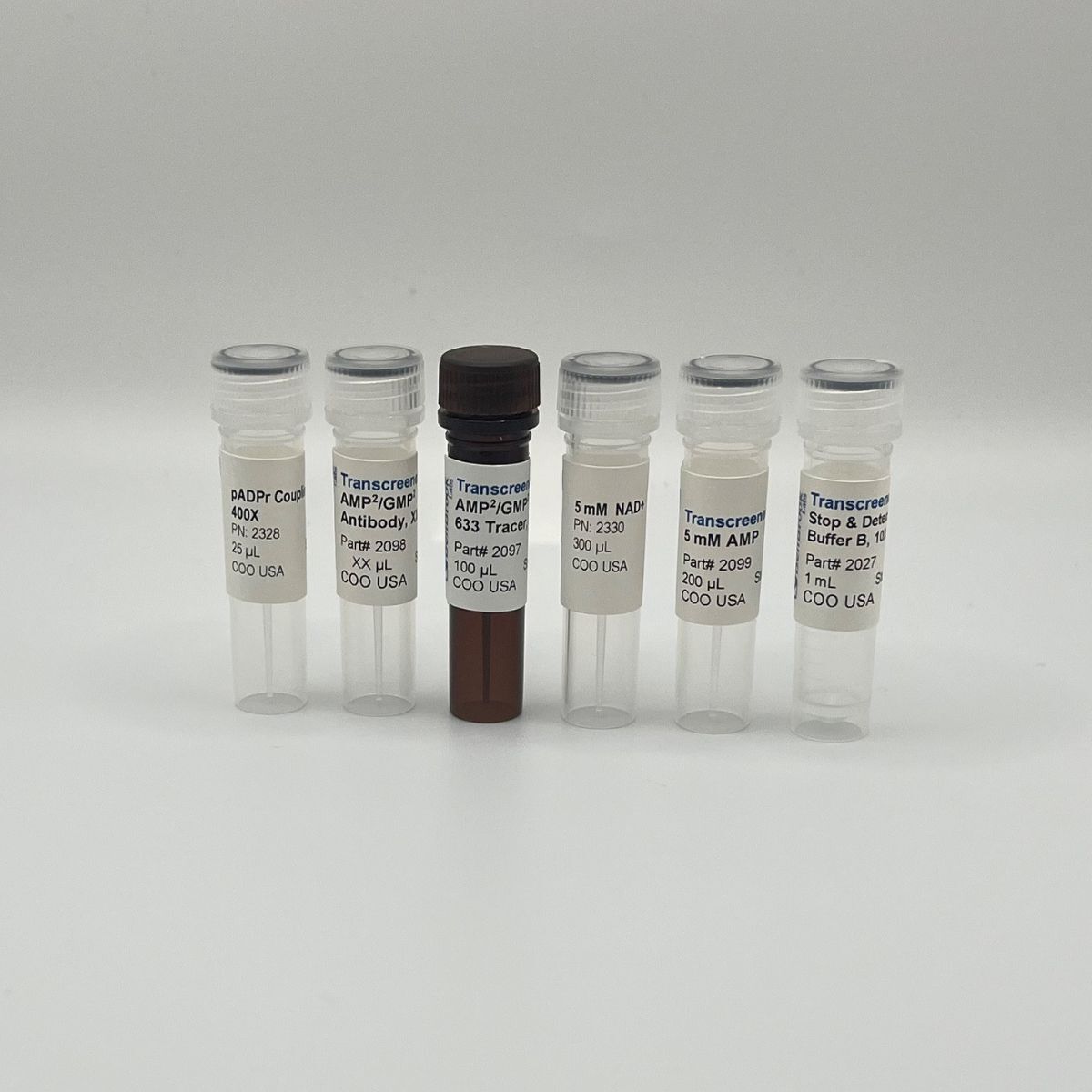
Transcreener® pADPr PARP Assay Kits
Single-Step PARP Assay for Screening and Lead Discovery
Is your plate reader compatible? Find out now!
Custom Sizes and Bulk Pricing Available Contact Us for an HTS-scale Quote!
Is your plate reader compatible? Find out now!
Custom Sizes and Bulk Pricing Available Contact Us for an HTS-scale Quote!
Transcreener pADPr PARP Assay measures poly(ADP-ribose) (pADPr) produced in poly(ADP-ribose) polymerase (PARP) reactions. pADPr measurements allow researchers to effectively determine the enzyme’s activity. The assay provides a powerful tool to screen compound libraries for PARP modulators to help find new therapies for disease.
The PARP activity assay kit comes complete with the detection reagents required to measure activity. PARP enzyme is not included in the inhibitor screening assay kit. Recombinant PARP1 and PARP2 enzymes, as well as Enzolution PARP1 and PARP2 Assay Systems, are available for separate purchase through BellBrook Labs.
This PARP assay is designed to be used with purified enzyme preparations. Transcreener assays are not validated with cell lysates, blood, serum, or other biological samples.
The Transcreener pADPr PARP FP Assay is a biochemical HTS assay for measuring the production of poly(ADP-ribose) (pADPr) in poly(ADP-ribose) polymerase (PARP) reactions.
The assay relies on pADPr Coupling Enzymes (CE) to convert pADPr into AMP, which is then detected using a far-red, competitive fluorescence polarization (FP) or TR-FRET assay. Detection is powered by a highly selective pADPr antibody, enabling sensitive measurement of ADP-ribose production.
As an example, the assay can be used to detect the activity of human PARP1, which uses NAD+ to form pADPr on itself, histones, and DNA repair proteins. The Transcreener pADPr PARP Assay is designed specifically for high throughput screening (HTS), with a single-addition, mix-and-read format.
It is easy to integrate into automated HTS workflows, with outstanding reagent stability (deck stability > 16 hours, signal stability > 24 hours), robust detection of ADPR monomers released from pADPr over a range of 10 nM to 100 μM, and compatibility with commonly used multimode plate readers. Data quality is excellent (Z’ ≥ 0.7), and the assay uses a far-red tracer to minimize interference from fluorescent compounds and light scattering.
High-Throughput PARP Inhibitor Screening with a Mix-and-Read Biochemical Assay
This video highlights a high-throughput, mix-and-read biochemical assay for quantitative PARP activity and inhibitor screening. Using enzymatic conversion of poly(ADP-ribose) to AMP with Transcreener® detection, the assay delivers exceptional sensitivity, automation compatibility, and accurate IC₅₀ determination for PARP drug discovery.
| FP | ||||
|---|---|---|---|---|
| 1K | 10K | |||
| Component | Part # | Qty | Part # | Qty |
| AMP2/GMP2 AlexaFluor® 633 Tracer, 800 nM | 2097 | 100 µL | 2101 | 1 mL |
| AMP2/GMP2 Antibody, 1.26 mg/mL | 2102 | 516 µL | 2122 | 2 X 1.7 mL |
| NAD+, 5 mM | 2330 | 300 µL | 2331 | 3 mL |
| AMP, 5 mM | 2099 | 200 µL | 2103 | 2 mL |
| pADPr Coupling Enzyme Mix, 400X | 2328 | 25 µL | 2329 | 250 µL |
| Stop & Detect Buffer B, 10X | 2027 | 1 mL | 2032 | 10 mL |
| TR-FRET | ||||
|---|---|---|---|---|
| 1K | 10K | |||
| Component | Part # | Qty | Part # | Qty |
| AMP2/GMP2 Hilyte 647 Tracer, 10 µM | 2332 | 400 µL | 2333 | 4 mL |
| AMP2/GMP2 Antibody Tb, 800 nM | 2158 | 100 µL | 2160 | 1 mL |
| NAD+, 5 mM | 2330 | 300 µL | 2331 | 3 mL |
| AMP, 5 mM | 2099 | 200 µL | 2103 | 2 mL |
| pADPr Coupling Enzyme Mix, 400X | 2328 | 25 µL | 2329 | 250 µL |
| Stop & Detect Buffer B, 10X | 2027 | 1 mL | 2032 | 10 mL |
| Component | Notes |
|---|---|
| Ultrapure Nuclease Free Water | Some deionized water systems are contaminated with enzymes that can degrade both nucleotide substrates and products, reducing assay performance. Use nuclease free water such as: Invitrogen Part # AM9930 |
| Enzyme | You can purchase active PARP1 enzyme and PARP2 enzyme directly through BellBrook Labs. |
| Acceptor Substrate | PARP1 and PARP2 can ADP-ribosylate itself and does not require addition of an additional acceptor substrate. If a separate acceptor substrate is used, it should be highly purified to avoid degradation of AMP by contaminating enzymes. |
| Plate Reader | A multi-detection plate reader configured to measure the output of the AMP tracer is required. |
| Liquid Handling Devices | Use liquid handling devices that can accurately dispense sub-microliter volumes into 384-well plates. |
| Assay Plates | Assay Plates Can Be Purchased Separately From BellBrook Labs. FP - An entirely black plate with a non-binding surface is required. We suggest Corning 384-well plates (Cat. #4514) or 1536-well plates (Cat. #3728). TR-FRET - An entirely white plate with a non-binding surface is required. We suggest Corning 384-well plates (Cat. #4513) or 1536-well plates (Cat. #3729). |
Run your enzyme reaction, add Transcreener reagents, and read your plates. The PARP assay is compatible with 96, 384, and 1536-well formats, making it ideal for scalable screening campaigns.
PARP1 enzyme titration using the Enzolution PARP1 Assay System. The assay demonstrates linearity when raw data is converted to AMP using a standard curve.
PARP2 enzyme titration using the Enzolution PARP2 Assay System. The assay demonstrates linearity when raw data is converted to AMP using a standard curve.
The Transcreener pADPr Assay is designed for screening compound libraries in a high throughput format. Follow up SAR can also be performed using the assay to determine inhibitor potency with ease.
Example dose-response curves with known PARP1 inhibitors. Data was generated using the Transcreener pADPr PARP FP Assay, with the Enzolution PARP1 Assay System. The following conditions were used. 50 mM Tris-HCl (pH 7.5), 10 mM MgCl2. 0.6 nM full-length human PARP1, 50 µM NAD+, 0.25 mg/mL Sheared Salmon Sperm DNA, with 1X pADPr coupling enzyme mix. The enzyme was incubated with the test compound for 30 minutes before the addition of CE/substrate mix and allowed to incubate for 60 minutes. The 1X AMP detection mix was added and incubated for 120 minutes, and the plates were read via a plate reader.
Active, full-length human PARP1 (AA 1-1014) protein expressed and purified from Baculovirus infected insect cells with an N-Terminal FLAG tag. The enzyme has been thoroughly validated with the Transcreener pADPr Assay Kit. For specific activity, please refer to the Certificate of Analysis for each individual enzyme lot. Purity is >80% in a composition of 25 mM HEPES, 300 mM NaCl, 0.04% Triton X-100, 0.5 mM TCEP, and 10% Glycerol (pH 7.5). Currently used with the Transcreener assay at a concentration of between 0.6 nM to 1 nM in a 10 μL reaction. Please adjust the enzyme concentration based on your requirements.
Active, full-length human PARP2 (AA 1-583) protein expressed and purified from Baculovirus-infected insect cells with an N-terminal His tag. The enzyme has been thoroughly validated with the Transcreener pADPr Assay Kit. For specific activity, please refer to the Certificate of Analysis for each individual enzyme lot. Purity is >90% in a composition of 50 mM TRIS, 500 mM NaCl, and 5% Glycerol (pH 8.0). Currently used with the Transcreener assay at a concentration of 3 nM in a 10 μL reaction. Please adjust the enzyme concentration based on your requirements.
Interested in moving your PARP1 or PARP2 program forward, but don’t want the hassle of bringing an assay in-house? BellBrook’s expert scientists have you covered.
Our team of biochemical and enzymology expert scientists work diligently to progress your lead candidates through the early stages of drug discovery. The best part – we are a small custom shop, so you will collaborate directly with one of our scientists. Additionally, we can customize assay conditions to suit your project needs and help you produce results faster.
Lead Discovery Services Include:
Have questions about implementing this PARP assay kit or outsourcing screening services? Please fill out the form below.
Our team responds quickly, works discreetly, and collaborates directly with you to move your discovery program forward.
There is extensive crosstalk between the DNA damage response (DDR) pathways and innate immune pathways. Both the individual pathways and the interconnections between them are a focus for exciting new small molecule drug therapeutics that target cancers and debilitating autoimmune disorders. The Transcreener HTS Assay platform accelerates these efforts by providing a robust and easy-to-use biochemical assay to measure activity of key enzymes in the innate immune and DDR pathway.
In this guide, we provide an overview of the DDR and innate immune pathway, and describe Transcreener Assays and Assay Systems for key therapeutic targets. The enzyme targets discussed include:
PARP1 is an essential enzyme in DNA repair, particularly for fixing single-strand breaks through base excision repair. Its role in maintaining genomic stability makes PARP1 a key target in cancer therapy.
Upon detecting DNA damage, PARP1 binds to the site and catalyzes the transfer of ADP-ribose from NAD+ to itself and other proteins, a process called poly(ADP-ribosyl)ation. This action recruits additional DNA repair proteins. Inhibiting PARP1 hinders DNA repair, especially in cancer cells, leading to an accumulation of DNA lesions. This mechanism can result in synthetic lethality, making PARP1 inhibitors particularly effective for cancers with defective homologous recombination, such as those with BRCA1 or BRCA2 mutations.
Multiple PARP inhibitors are currently used in cancer treatments, targeting PARP1 to kill cancer cells. Research is also exploring their potential in treating neurodegenerative diseases like Alzheimer’s and Parkinson’s, as well as inflammatory conditions such as rheumatoid arthritis.
PARP1 inhibition is a promising therapeutic strategy for cancers with flawed DNA repair mechanisms, with potential applications extending to other diseases linked to DNA damage.
Find the right resources to help you get to your solution faster.
Need support or have questions? Please fill out the form below. We will respond quickly to get the conversation moving and learn how we can help. We keep things discrete, confidential, and professional.
“Some CROs reserve their best teams for high profile customers. If you’re not right there with them you get less experienced teams… BellBrook understands enzyme kinetics, so it made that part of the project so much easier. The larger CRO didn’t seem to have the expertise we needed in this area.”
“The ADP assay is a great choice for measuring activity for any ADP-generating enzyme in both real time and endpoint formats. The universal detection system has been very useful for more challenging targets.”
“Excellent blend of simplicity & good science. Excellent technical support”
“The assay itself has good reproducibility and provides a clear readout on our enzyme activity. The most important piece, however, is the level of attention to our project and rapid turnaround time. The staff at BellBrook knows what they are doing.”
“The Transcreener AMP/GMP Assay is extremely straightforward to use and is very sensitive. In a UV-based enzyme assay I needed 1 µM enzyme to see a decent signal; however using the Transcreener AMP assay I only need 10 nM. Also, BellBrook Labs have been very helpful with the assay development. Their representative has been very willing to quickly help me get my assay up and running.”
“Through the process of developing and validating an assay for HTS applications, I generated a very nice data package of robust high quality data.”
BellBrook Labs
1232 Fourier Drive, Suite 115
Madison, Wisconsin 53717 USA
(608) 443-2400
info@bellbrooklabs.com
This site uses cookies. By continuing to browse the site, you are agreeing to our use of cookies.
Accept settingsHide notification onlySettingsWe may request cookies to be set on your device. We use cookies to let us know when you visit our websites, how you interact with us, to enrich your user experience, and to customize your relationship with our website.
Click on the different category headings to find out more. You can also change some of your preferences. Note that blocking some types of cookies may impact your experience on our websites and the services we are able to offer.
These cookies are strictly necessary to provide you with services available through our website and to use some of its features.
Because these cookies are strictly necessary to deliver the website, refusing them will have impact how our site functions. You always can block or delete cookies by changing your browser settings and force blocking all cookies on this website. But this will always prompt you to accept/refuse cookies when revisiting our site.
We fully respect if you want to refuse cookies but to avoid asking you again and again kindly allow us to store a cookie for that. You are free to opt out any time or opt in for other cookies to get a better experience. If you refuse cookies we will remove all set cookies in our domain.
We provide you with a list of stored cookies on your computer in our domain so you can check what we stored. Due to security reasons we are not able to show or modify cookies from other domains. You can check these in your browser security settings.
We also use different external services like Google Webfonts, Google Maps, and external Video providers. Since these providers may collect personal data like your IP address we allow you to block them here. Please be aware that this might heavily reduce the functionality and appearance of our site. Changes will take effect once you reload the page.
Google Webfont Settings:
Google Map Settings:
Google reCaptcha Settings:
Vimeo and Youtube video embeds: